

How the Tarot Hermit Card Guides Your Path
, by Nika White, 21 min reading time
, by Nika White, 21 min reading time
Delve into the Tarot Hermit card guide for profound insights on love, relationships, and life decisions. Enhance your personal growth and spirituality with our expert interpretations.
The Hermit card is the ninth trump or Major Arcana card in many traditional tarot decks. As a symbol steeped in introspection and inner wisdom, it plays a crucial role in the spiritual journey depicted by the tarot. This card often suggests a time of seeking solitude and guidance from within, prompting a period of self-reflection and soul-searching that can lead to significant personal insights and enlightenment.

In readings, I interpret The Hermit as a call to withdraw from the external world to focus on inner growth. The imagery of a solitary figure holding a lantern usually represents the light of knowledge guiding the conscious mind to the deeper parts of the self. This trek into the depths isn't about isolation for its own sake but serves the purpose of gaining a deeper understanding of one's goals, fears, and true essence, which can only be accomplished in stillness and quiet.
Drawing The Hermit may also be an indication of wisdom and maturity, suggesting that through contemplation and introspection, one can illuminate the truths that are hidden in the shadows of the unconscious. It's a reminder that the answers we seek often lie within and that solitude can be a profound pathway to discovering them.

The Hermit Tarot card is a potent symbol of introspection and guidance on the spiritual journey. In the Tarot, it offers a moment for reflection and a beacon for wisdom.
The Hermit represents a stage of inner reflection and the quest for deeper truth. As a part of the Major Arcana, this card symbolizes a period of solitary introspection and the pursuit of knowledge. I often see it as an encouragement to step back from the external world to consult one's inner wisdom and seek clarity. The Hermit advises taking time to ponder over one's path forward, emphasizing the wisdom that comes from solitude and contemplation.
In Tarot, the Major Arcana is a suite of 22 cards that speak to the grand themes of life's journey and spiritual lessons. The Hermit is the ninth card of this suite and marks a midpoint in the archetypal narrative of the Major Arcana. It’s a turning point where external achievements give way to a search for meaning, inner growth, and enlightenment. This card's appearance in a reading often signals a necessary pause for self-reflection and assessment of one's direction.
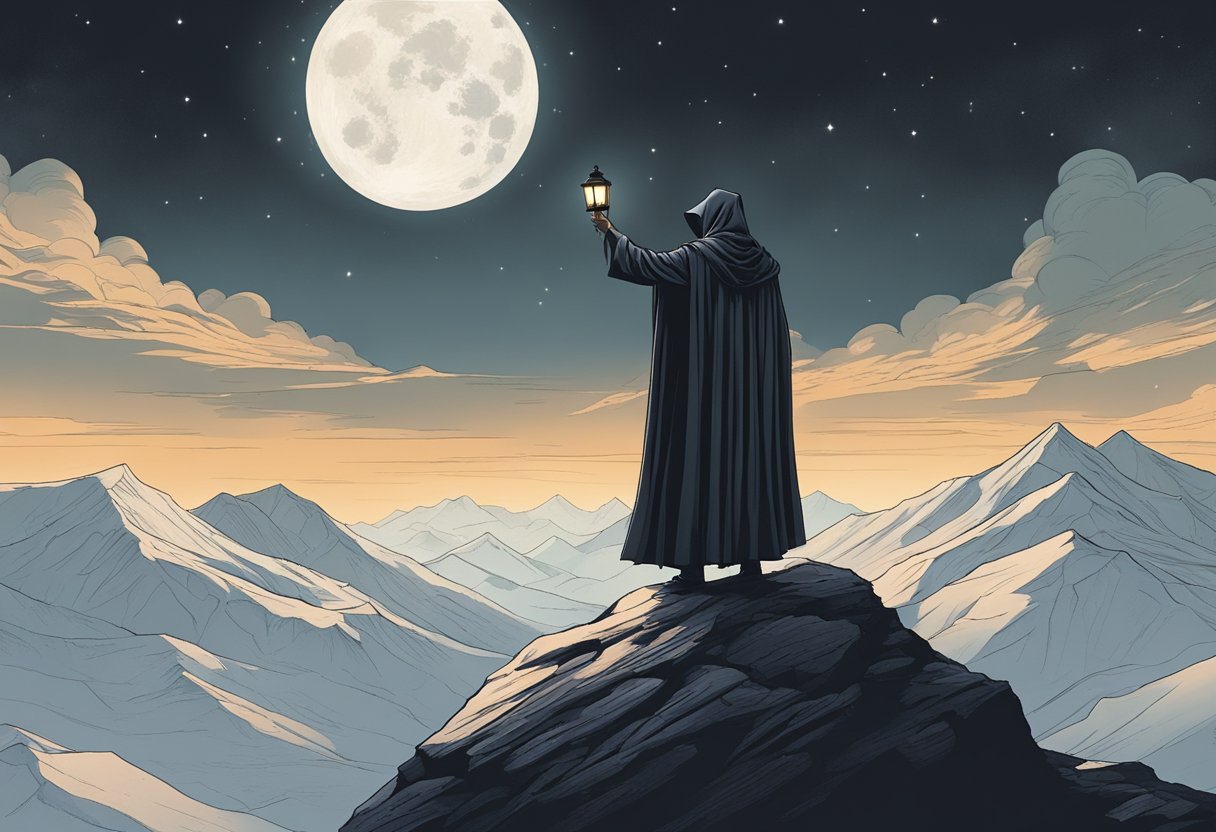
The symbolism of the Hermit Tarot card is rich with meaning. The figure of the Hermit itself is a key symbol, often depicted as an elderly sage who stands alone at the peak of a mountain, holding a lantern. This lantern, typically containing a six-pointed star, represents the search for truth and the light of spiritual knowledge. His staff is another important element, symbolizing authority, stability, and the journey he undertakes. The stark, snowy landscape often surrounding the Hermit signifies the potentially cold and challenging path to enlightenment and the isolation needed for introspection. The overall imagery of the Hermit Tarot card nudges me to look within for answers and signifies that wisdom and guidance are often found in the quiet moments of solitude.

The Hermit card, with its veiled beginnings and multifaceted symbolism, has a profound heritage that correlates with ancient astrology and mystical systems.
In the 15th century Italy, my starting point for the exploration of The Hermit card reveals a figure that diverged notably from today's interpretation. Initially, The Hermit did not depict an old man with a lantern, an emblem of introspection. Instead, this character held different meanings and attributes across various early tarot decks.
Astrologically, I find that The Hermit is intricately connected to Virgo, the zodiac sign known for meticulousness and analytical traits. The Virgin's symbol reflects a meticulous nature that aligns well with the archetype of The Hermit, often shown as a wise seeker of truth. Additionally, my investigation uncovers a notable correlation with Saturn, the ruling planet of Capricorn, known for its effects on introspection and wisdom, further enhancing The Hermit's astrological depth.
When I position The Hermit within the Kabbalistic Tree of Life, it interlinks with the spheres of Tiphareth and Chesed. Tiphareth, the sphere associated with balance and beauty, encapsulates The Hermit’s quest for harmony and enlightenment. In concordance, Chesed, representing kindness and mercy, marks an expansion of The Hermit's capacity for understanding and benevolence. These connections underscore The Hermit as a beacon of inner guidance and compassion.

In exploring the Tarot Hermit card, I find specific symbols that carry profound meanings. These elements represent guidance, support, introspection, and the journey through life's solitary phases.
The Hermit holds a lantern, which I understand to contain a bright six-pointed star, often seen as a symbol of the inner light. This element underscores my belief in the Hermit's quest for knowledge and truth—his lantern lights the way through darkness, embodying wisdom and the illumination of the mind. This symbolic light serves both as guidance for the Hermit and as an allegory for enlightenment seekers must find within themselves.
Adorning the Hermit, the cloak stands for protection, enveloping him as he traverses the harsh reality of his path, similar to how being alone can shield us from the distractions of the outer world. In his other hand, the staff, a symbol of stability and power, enables me to perceive the importance of a strong foundation and support in the journey towards enlightenment. Additionally, symbols like the hourglass may sometimes be depicted, which highlight the passage of time and the wisdom that comes with observation and experience in nature.
The Hermit's setting is typically a barren landscape or mountaintop, emphasizing the theme of seclusion in the wilderness. This represents my perspective on the Hermit's deliberate choice to seek solitude in order to reflect and gain deeper insights away from society's noise. Such an environment denotes a period of introspection where nature's undisturbed state fosters a clear observation of the self and one's surroundings.

In my examination of the Hermit tarot card, I discern its associations with introspection and the pursuit of deeper understanding. I see it as a beacon for those who seek to illuminate their path through personal reflection and inner wisdom.
The Hermit is emblematic of the quest for wisdom. As a symbol of guidance, this card reflects my belief in the value of internal counsel above all. Often, when I consider the Hermit's significance, I recognize it as a reminder to trust my own inner guidance and to apply the knowledge gained from life's experiences when facing decisions. Here is a representation of wisdom attributes aligned with the Hermit:
The act of self-reflection is central to the Hermit's character. When I contemplate this tarot card, it tells me that a time for soul-searching is necessary to achieve clarity and understand my true desires. It stands as an invitation to delve deep into my own psyche, to unearth and confront the truths that define me. Elements of self-reflection and soul-searching that resonate with me:
The Hermit asserts the importance of solitude for personal growth and balance. I see this as a call to temporarily withdraw from external influences to focus on developing my inner sanctuary. This time alone is not about isolation; rather, it's a purposeful separation that allows me to recharge and achieve balance in my life. Aspects of solitude that I find significant include:
In the realm of tarot, the Hermit holds symbolism that offers a reflective perspective on love and relationships. It sheds light on inner wisdom and the need for personal space within interpersonal connections.
When the Hermit appears in a reading concerning love, it often signifies a time for contemplation and self-discovery. In the sphere of romance, this can translate to several situations:
Single Individuals: For those not in a relationship, the Hermit encourages taking a step back to understand past experiences. This time spent in solitude can be vital for healing and preparing oneself for future connections.
| Aspect | Insights |
|---|---|
| Healing | Reflect on past hurts to find closure and readiness to embark on new relationships. |
| Self-Discovery | Use this time to determine what you truly seek in a relationship and a partner. |
Partners in a Relationship: If I am in a relationship and the Hermit shows up in our joint reading, it may imply the need for introspection within the relationship itself.
The presence of the Hermit in contexts of love can also shine a light on the dual aspects of loneliness and support:
Loneliness: The Hermit invites one to distinguish between constructive solitude and detrimental isolation. If one feels lonely, it might be a cue to reconnect with oneself and find contentment in one's own company before seeking fulfillment externally.
Support: This card underscores the significance of support in love and how it manifests.

In my exploration of the Tarot Hermit card, I've uncovered its profound implications for personal growth and decision-making in areas such as career and finances.
My understanding of the Hermit card extends to its symbolism of introspection and guidance in career matters. When the Hermit appears in a career-oriented spread, it suggests a phase where deep reflection on one's career path is paramount. I advise taking time to contemplate career choices and potentially seek wisdom from mentors or advisors.
The Hermit card indicates the importance of self-reliance rather than hasty decision-making. It promotes the idea of patiently building one's skill set and knowledge base before advancing in a career.
Regarding finances, the Hermit encourages a measured and prudent approach to financial planning. I've learned that this card shines a light on the need for financial introspection—assessing one's budget, expenses, and investment decisions with a strategic mindset.
The card also warns against impulsive financial actions, suggesting that informed and cautious investments are more likely to yield long-term benefits. The essence of the Hermit is to find a balanced and thoughtful approach to financial endeavors.

In the journey of personal growth and spirituality, I find the act of looking inward is as crucial as the pursuit of peace through meditation. It is a deliberate practice that awakens my inner voice and sharpens my intuition.
Through the process of introspection, I unlock crucial realizations about my own being. I take time to examine my thoughts and actions, which often leads to substantial personal insights.
Meditation provides a conduit to tranquility that enriches my spiritual growth. By establishing a routine practice, I cultivate a sense of calm that sustains me.
As I deepen in my spiritual practice, I hone the ability to listen to my inner voice and trust my intuition. This inner guidance system becomes more pronounced, allowing for clearer and more deliberate decisions.

In exploring the Hermit tarot card, I often find that its significance lies within the realms of solitude for personal development and the pursuit of enlightenment. It's a journey inward that can manifest as both a challenge and a transformative experience.
The act of retreating into isolation, as symbolized by the Hermit, is a voluntary action. I see it as a statement of intent to disconnect from external distractions. Here, isolation does not imply loneliness but rather an opportunity for intense self-reflection. This form of seclusion allows individuals to confront their innermost thoughts and feelings, free from the influence of their immediate social environment. It's a space to:
Every retreat serves a purpose, whether it's to gain deeper insight into one's self or to emerge from a period of solitude with a renewed sense of direction.
In my understanding, the Hermit's pursuit of clarity through isolation results in heightened awareness and observation of the self. The journey leads to:
By stepping away from the noise of the everyday, I find that the Hermit's solitude is not about escapism but about seeking wisdom through contemplation. This card embodies the process of observing one's life with a clear and neutral perspective, which often leads to greater spiritual and emotional intelligence.

I find that The Hermit card often surfaces during tarot readings to offer profound guidance and shed light on the need for deeper introspection.
In my experience with tarot readings, The Hermit serves as a beacon when it comes to various aspects of an individual's life. Whether it concerns one’s personal growth, career paths, or relationships, The Hermit encourages a period of reflection and solitude. Here's how I perceive its guidance across different life areas:
In divination, I place great importance on the context and position of The Hermit within a spread, as it can vary the interpretation. Upright, The Hermit often indicates a quest for knowledge and truth, suggesting that the querent may need to seek answers within. In contrast, if The Hermit appears reversed, it can signify isolation or withdrawal stemming from fear or avoidance.
In a Reading:

In my exploration of Tarot's Hermit, I draw parallels to other archetypes and dissect the complex layers of personal development they represent.
The Hermit and the High Priestess both serve as beacons of introspection in the Tarot, yet their paths diverge significantly. While The Hermit represents an outward journey for inner truth, often associated with solitude and the active pursuit of enlightenment, the High Priestess embodies inner wisdom and the intuitive understanding that comes from stillness.
The Hermit:
The High Priestess:
Mental maturity within these archetypes is a reflection of the soul's progression towards an enlightened state. The Hermit, clutching a lantern, signifies the pursuit of knowledge and the illumination of the mind’s darker recesses. This journey is marked by:
Enlightenment for The Hermit means reaching a state of mental and emotional maturity, where wisdom is both sought and ultimately found.
Creativity and independence are cornerstones of The Hermit's identity. This archetype steps away from social constructs to foster a unique path:
On a personal level, I perceive creativity as a direct byproduct of a strong independent streak, often seen in those who exhibit The Hermit's personality. Through this self-imposed isolation, there's a liberation that encourages most unconventional and trailblazing ideas.
The Hermit card carries profound symbolism and implications in tarot readings, touching on themes of introspection, solitude, and guidance. My expertise on tarot cards enables me to shed light on some of the intriguing nuances of the Hermit card, specifically concerning its various positions and contexts within different readings.
In tarot readings, the Hermit typically signifies a period of introspection and self-examination. It often suggests that it's time for me to look inward for answers, rather than seeking external solutions. The Hermit's lantern is a beacon of inner wisdom and may indicate a quest for knowledge that leads to a profound understanding and truth.
When the Hermit appears in a reversed position, it may indicate isolation or withdrawal that has become counterproductive. It might be a sign that I have been spending too much time in contemplation or solitude and need to reconnect with the world. Alternatively, it could suggest that I am neglecting my inner world and need to pay more attention to my internal voice.
In matters of relationships and love, the Hermit can suggest a time to step back and reflect on my relationship needs and goals. It may be a call to appreciate the value of a relationship that encourages personal growth. If I'm single, the Hermit might indicate a period of self-discovery before entering into a new relationship.
The Hermit doesn't typically lend itself to a straightforward yes or no answer. Instead, it asks me to consider what I can learn from my situation and how I can use that knowledge for my personal development. The Hermit encourages me to seek answers within and may imply a "maybe," suggesting a period of contemplation is necessary.
The Hermit card is a powerful symbol of personal growth and introspection. It encourages me to look within and to trust my inner guidance system. Through reflection and self-exploration, the Hermit can represent my journey towards enlightenment and the evolution of my understanding of myself and the world around me.
The Hermit card places an emphasis on the importance of solitude in the process of self-discovery. In a tarot spread, it advises that taking time alone is vital for my personal and spiritual growth. This solitude can provide the quiet and space necessary to connect with my innermost thoughts and to hear the subtle messages of my inner guidance.